How to Read a Slot Paytable: The Complete Guide to Understanding Every Symbol, Payout & Feature

CEO & Co-Founder

Quick Answer Box
What is a slot paytable? A slot paytable is a built-in information screen that shows you everything about a game before you bet: the value of each symbol, the payline patterns, bonus feature triggers, RTP percentage, volatility rating, and min/max bet limits. You can access it by clicking the "i", "?", or "Info" button on any online slot. Reading the paytable before you play is the single most important habit for making informed decisions about which slots to play and how much to wager.
What Is a Slot Paytable and Why Should You Read It?
A slot paytable is the user manual built into every online slot machine. It contains all the information the game developer is required to disclose about how the game works, what each symbol pays, how bonus features trigger, and what the game's theoretical return looks like over time.
Most players skip it entirely. They load a game, set a bet, and start spinning — only discovering halfway through a session that they have no idea what the scatter symbol does, why certain wins feel small, or what triggered the bonus round they just entered. This is like driving a car without looking at the dashboard.
Reading the paytable takes two minutes and gives you complete clarity on every aspect of the game. It tells you which symbols you should be hoping for, how many you need for a meaningful payout, what the bonus round looks like before you enter it, and whether the game's volatility and RTP match your goals and bankroll. Every guide on Chase the Scatter starts with the paytable — because it is the foundation of informed play.
If you are working through our Start Here learning path, this is Step 1 for a reason. The concepts you learn here — symbol values, paylines, RTP, volatility — carry through every other guide in the library.
Where Do You Find the Paytable on an Online Slot?
The paytable is accessible from inside every online slot. Look for one of these icons, usually in the bottom-left corner of the game screen:
An "i" icon (the most common)
A "?" icon
A menu/hamburger icon (three horizontal lines)
A button labelled "Info", "Help", "Paytable", or "Game Rules"
Clicking this opens a multi-page overlay that you can scroll through. Different providers organise the information differently, but the core content is the same across every game.
On mobile, the paytable button is sometimes hidden behind a settings menu or in the game's hamburger navigation. It is always there — game regulators require it.
One important note: paytables show the game's built-in information. This is different from the casino's promotional page for the game, which might highlight features selectively. The paytable is the complete, accurate source from the game developer.
What Are the Different Types of Symbols on a Slot?
Every slot game uses a hierarchy of symbols, each with different payout values. Understanding this hierarchy is the first thing you should do when opening a paytable.
Low-Value Symbols (Royals / Fillers)
Most modern slots use playing card symbols — 10, J, Q, K, A — as their low-value icons. Some games substitute other simple graphics like gems, flowers, or basic shapes. These symbols appear frequently and pay small amounts. They exist to create the sensation of winning while keeping the overall payout balanced.
In the paytable, you will see each low-value symbol displayed with its payouts for different match counts (typically 3, 4, and 5 of a kind). For example, a "10" symbol might pay 0.5x for three, 1x for four, and 2.5x for five on a payline. These values are relative to your bet size.
High-Value Symbols (Thematic / Premium)
The premium symbols are theme-specific. In an Egyptian-themed slot, these might be pharaohs, scarabs, and ankhs. In an adventure-themed game, they might be treasure chests, compasses, and maps. High-value symbols pay significantly more than royals — often 5x to 50x your bet for a five-of-a-kind combination.
The paytable lists these from highest to lowest value. Familiarising yourself with the top two or three premium symbols helps you instantly recognise when a spin has real potential. You learn to watch the reels with context rather than confusion.
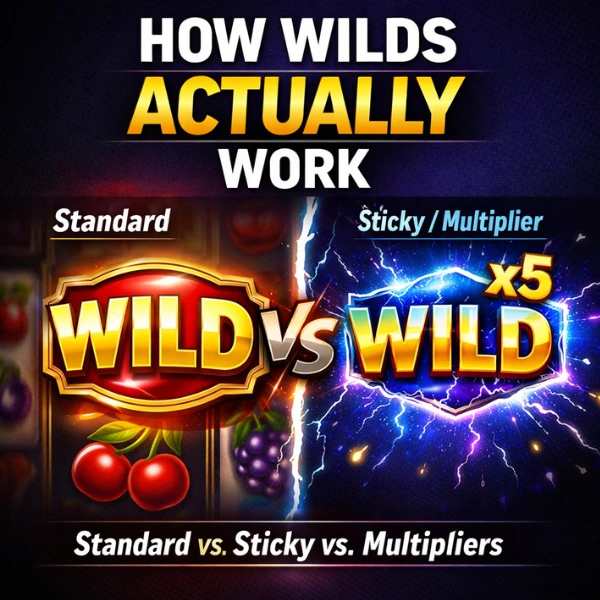
Wild Symbols
Wild symbols substitute for other regular symbols to help complete winning combinations, much like a joker in a card game. In most slots, wilds cannot replace scatter or bonus symbols.
The paytable will tell you exactly what the wild can and cannot do in the specific game you are playing. Some wilds also carry their own payout — meaning a line of five wilds pays a specific amount, often the highest base game payout. Others only function as substitutes with no standalone value.
Modern slots feature many wild variants. Our complete wild symbols guide covers expanding wilds, sticky wilds, multiplier wilds, walking wilds, and more. The paytable is where you discover which wild type the game uses, and this has a direct impact on how the game plays.
Scatter Symbols
Scatter symbols are the key to unlocking bonus features. Unlike regular symbols that need to land on a specific payline, scatters typically pay anywhere on the reels as long as enough of them appear on screen.
The paytable will show you exactly how many scatters trigger the bonus (usually 3, 4, or 5), what the bonus is (free spins, pick-and-click, wheel spin, etc.), and whether landing additional scatters during the bonus gives extra spins or other rewards. This information is critical — it tells you what you are playing towards in every base game spin.
Some games also feature scatter pays where symbols pay based on their total count anywhere on screen, independent of paylines entirely.
Bonus and Special Symbols
Many modern slots include additional symbols beyond wilds and scatters: coins, mystery symbols, multiplier symbols, collector symbols, and more. The paytable will explain each one. These special symbols are often what make a game unique, and skipping the paytable means you will not understand the mechanic that the entire game is built around.
How Do Paylines Work and What Patterns Should You Look For?
Paylines are the patterns that determine whether a combination of symbols counts as a win. The paytable always includes a visual diagram showing every payline pattern in the game.
Fixed Paylines
Most modern online slots use fixed paylines — you cannot adjust the number of active lines. Every spin plays all paylines. The paytable will show you patterns like the simple horizontal middle line, various diagonal patterns, zigzag patterns, and V-shaped patterns. A standard 5-reel slot might have anywhere from 10 to 50 fixed paylines.
Winning combinations are read left to right in most games, starting from the leftmost reel. Some games also pay right to left — the paytable will clearly state this, and you can read more about this in our win both ways guide.
Ways to Win (243, 1024, and Beyond)
Instead of traditional paylines, many games use a "ways to win" system. A standard 5×3 grid with 243 ways to win counts any matching symbol on adjacent reels as a win, regardless of position. The paytable for these games shows that matching symbols need to appear on consecutive reels starting from the left, but can be in any row position.
Megaways slots take this further with dynamic reel sizes that can offer up to 117,649 ways to win on a single spin. Our reels and paylines guide explains these structures in detail, but the paytable for any specific game will tell you exactly which system it uses.
Cluster Pays
Some games abandon paylines entirely. Cluster pays slots require groups of matching symbols to touch horizontally or vertically — no paylines involved. The paytable will specify the minimum cluster size (usually 5 or more symbols) and how payout scales with cluster size.
The key takeaway: every game has a different win structure, and the paytable tells you exactly which one you are dealing with. Never assume a game works the same way as the last one you played.
How Do You Read Symbol Payout Values in the Paytable?
Symbol payouts in the paytable are displayed either as multipliers of your bet or as coin values. Understanding which format the game uses prevents confusion about what you have actually won.
Multiplier Format (Most Common Online)
Most online slots display payouts as multipliers relative to your total bet. If a symbol shows "5x" for a five-of-a-kind, and you are betting £1 per spin, that combination pays £5.
The paytable typically shows values for three, four, and five matching symbols (or whatever the minimum and maximum counts are for the game). For example:
Premium Symbol A: 3 = 2x | 4 = 5x | 5 = 25x
Premium Symbol B: 3 = 1x | 4 = 3x | 5 = 15x
Royal K: 3 = 0.4x | 4 = 0.8x | 5 = 2x
These values tell you the game's payout structure at a glance. If the highest base game symbol only pays 25x for five-of-a-kind, the game is built around its bonus features for big wins (common in high-volatility slots). If base game symbols pay 100x or more, the game distributes more value in regular play.
Coin Value Format
Some slots (particularly older titles or certain providers) show payouts in coins rather than bet multipliers. In this case, you need to know your coin denomination and how many coins you are betting per line to calculate the actual cash payout. The paytable or game settings will explain the relationship between coins and your real-money bet.
Dynamic Paytables
Some newer slots change symbol values based on your bet level. Higher bets may unlock higher multipliers or additional features. The paytable will clearly indicate when this is the case — look for different payout tables at different bet levels, or text stating "values shown for current bet."
What Do RTP and Volatility Mean in the Paytable?
Two of the most important numbers in any paytable are RTP and volatility. These tell you the mathematical profile of the game.
RTP (Return to Player)
RTP is the percentage of all wagered money that the slot is designed to pay back over millions of spins. An RTP of 96.5% means that for every £100 wagered in aggregate over the long term, the game returns £96.50 and the house retains £3.50.
The paytable typically lists the RTP as a single percentage, sometimes with additional notes about whether the RTP changes with certain features (like the bonus buy option, which often has a slightly different RTP than base game play).
Important: some slots have adjustable RTP, meaning the casino operator can select from several RTP settings. The paytable shows the theoretical RTP set by the developer, which may or may not match the version the casino is running. Look for language like "RTP ranges from 94.5% to 96.5%" — this is a flag to verify which version the specific casino offers.
Our complete RTP guide explains how to evaluate RTP in the context of your actual play sessions.
Volatility / Variance
Volatility describes how the game distributes its payouts. The paytable may display this as a scale (Low / Medium / High), a number rating, or it may not show it at all (in which case you can infer it from the symbol values and game structure).
Low-volatility slots pay small wins frequently. High-volatility slots pay larger wins infrequently, with longer dry spells in between. Two games with identical RTP can feel completely different because of their volatility.
Our volatility and variance guide goes deep on how to match volatility levels to your bankroll size and session goals.
What Bet Limits and Settings Does the Paytable Show?
The paytable specifies the game's minimum and maximum bet, and how your total bet is structured.
Min and Max Bet
Every slot has a defined betting range. This might be £0.10 to £100, or £0.20 to £50, depending on the game. The minimum bet determines the cheapest way to play the game, which matters for bankroll management. The maximum bet determines the cap on your potential risk per spin.
Bet Structure
Some games have simple betting: you choose a total bet per spin. Others break it down into coin value × coins per line × number of lines. The paytable explains this structure so you understand exactly what you are wagering.
This is particularly important for bonus buy features, which typically cost 50x to 100x your base bet. If your base bet is £1 and the bonus buy costs 100x, you are paying £100 for a single bonus round. The paytable will list this cost and any rules or restrictions around the feature buy option.
Max Win Cap
Most modern slots have a maximum win cap — the absolute most you can win from a single spin or bonus round, expressed as a multiple of your bet. This might be 5,000x, 10,000x, or even 100,000x depending on the game. The paytable always discloses this, and it is an important factor in evaluating a game's potential.
How Do You Read Bonus Feature Rules in the Paytable?
The bonus features section is often the most detailed part of the paytable, and it is the section most players skip. Understanding what the bonus does before you enter it transforms the experience from confusion to anticipation.
Free Spins
The paytable tells you how many free spins you receive for different scatter counts, whether there is an increasing multiplier during free spins, whether extra scatters during the bonus retrigger additional spins, and whether any special symbols or mechanics are active exclusively during the bonus round.
Many slots alter their rules during free spins — wild symbols might become sticky, multipliers might progress with each avalanche win, or additional high-value symbols might be added to the reels. All of this is documented in the paytable.
Pick-and-Click, Wheel, and Other Bonus Types
Not all bonuses are free spins. The paytable explains every bonus type the game offers — pick-and-click prize reveals, wheel-of-fortune spins, trail bonuses, and more. Each will have its rules, prizes, and conditions documented.
Gamble / Risk Feature
Some slots offer a gamble feature that lets you risk a win for a chance to double it. The paytable explains the rules: coin flip, card colour guess, ladder climb, etc. It also states the maximum number of consecutive gambles allowed and any win cap on gambled amounts.
A Step-by-Step Checklist for Reading Any Paytable
Before you play any new slot, work through this checklist:
Open the paytable — find the "i", "?", or "Info" button
Check the RTP — is it 96% or above? Is it adjustable?
Check the volatility — does it match your bankroll and session length?
Learn the top 3 symbols — which premium symbols pay the most?
Understand the wild — what type is it? Does it have standalone payouts?
Understand the scatter — how many trigger the bonus? What is the bonus?
Read the bonus rules — what happens during free spins or the bonus feature?
Check the bet range — does the minimum bet work for your bankroll?
Check the max win — what is the ceiling on potential payouts?
Note any special mechanics — avalanche, cluster pays, Megaways, bonus buy, etc.
This entire process takes less than two minutes and gives you more game knowledge than most players accumulate in hours of confused spinning.
Recommended Slots for Practicing Paytable Reading
These games are available as free demos on Chase the Scatter, and each one teaches you something different about reading paytables. Open each demo and follow the checklist above before you start spinning.
Le Cowboy (Hacksaw Gaming) — A cluster pays slot with the Revolver Reveals feature and a Bullet Collector mechanic in the bonus rounds. The paytable clearly walks you through how clusters form wins instead of paylines, and how the collection mechanic builds multipliers across spins. A great example of a medium-volatility game with a well-documented multi-layered bonus system.
Iron Bank 2 (Relax Gaming) — One of the most detailed paytables you will find. This 6×4 slot with 4,096 ways to win features a Dual Base Feature toggle (Random Mystery vs Random Wilds), three different bonus rounds each with Standard, Super, and Ultra tiers, plus a bonus buy menu. If you can read and understand this paytable, you can read any paytable. Perfect for learning how complex feature documentation is structured.
Donny and Danny (Hacksaw Gaming) — A clean, modern paytable with a straightforward bonus structure. Medium volatility with a 96.29% RTP and a solid 12,500x max win. Good for beginners because the paytable is well-organised without being overwhelming — it teaches you the fundamentals of reading symbol values, scatter triggers, and bonus rules without too many layers.
Christmas Megapots (Big Time Gaming) — A Megaways slot with dynamic reel sizes, meaning the number of ways to win changes every spin (up to 117,649). The paytable explains this variable structure clearly. Also demonstrates how progressive jackpot information is documented alongside standard gameplay. Its 89,600x max win cap is one of the highest you will see, making the max win section particularly interesting to study.
Deal With Death (Hacksaw Gaming) — A slot that switches between Classic Mode and Poker Mode when a Joker lands. The paytable has to explain two completely different payout systems within a single game — standard slot paylines and poker hand evaluations. This is an advanced paytable to read, and working through it is the ultimate test of your paytable reading skills.
Recommended Slots

Frequently Asked Questions
Everything you need to know about this guide
About the Author
CEO & Co-Founder at Chase the Scatter
Former professional tennis player turned casino industry expert with over 10 years of experience in iGaming. Previously an operator at NOVOMATIC and Stanleybet Group, Borna now leads Chase the Scatter, delivering honest, data-driven slot reviews and expert gambling guides backed by real industry knowledge.