Hold and Win Slots Explained: How the Respin Mechanic Works

Lead Developer & Slot Reviewer
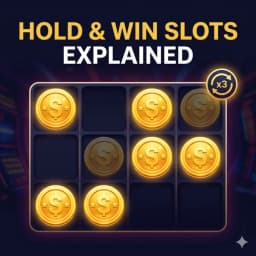
You've probably seen it dozens of times without knowing its name. A cluster of coins appears on the reels. Everything else disappears. A new grid lights up, a counter ticks down from three, and suddenly you're locked into the most tense thirty seconds slots can offer — watching symbols land and the counter reset, over and over, until either the grid fills up or the respins run out.
That's the Hold and Win mechanic — also called Hold and Spin, Hold & Respin, Lock and Spin, and Link and Win depending on which developer made the game. Different names, same DNA. It's one of the most recognisable bonus formats in modern online slots, and understanding exactly how it works gives you a completely different perspective on the games that use it.
What Is the Hold and Win Mechanic?
Hold and Win is a type of bonus round where special symbols — typically coins, orbs, gems, or cash prizes — land on the reels and lock into place, while the remaining positions respin. The goal is to collect as many of these locked symbols as possible before the respins run out, adding up their individual values for your final payout.
The mechanic originated with Aristocrat's Lightning Link series, which launched in land-based casinos around 2014. The format quickly became one of the most copied bonus structures in the industry. Today you'll find variants from virtually every major provider — Pragmatic Play, Betsoft, Playson, 3 Oaks, Booming Games, Relax Gaming, iSoftBet, and dozens more.
The reason it spread so fast is simple: players immediately understand it. Unlike Megaways engines or cluster pays grids, Hold and Win has a visible, cumulative reward structure. You can see the symbols, you can see their values, and you can see exactly what you're building toward. That transparency — combined with genuine jackpot potential — is why it became a genre-defining feature rather than just another bonus round.
It's also why, in 2026, the format is genuinely oversaturated. Because the core loop is easy to implement and reliably popular, it has been cloned, reskinned, and re-released by virtually every provider in the industry. The majority of Hold and Win releases today share the same mathematical blueprint underneath different artwork. When we review Hold and Win slots at Chase the Scatter, we're not just asking "does this mechanic work?" — we're asking whether a given game does anything meaningful with it. That question separates the genuinely interesting games from the long tail of interchangeable respin clones, and it shapes every verdict in the reviewed games section below.
How Hold and Win Works: Step by Step
Every Hold and Win round follows the same core loop, regardless of provider or theme.
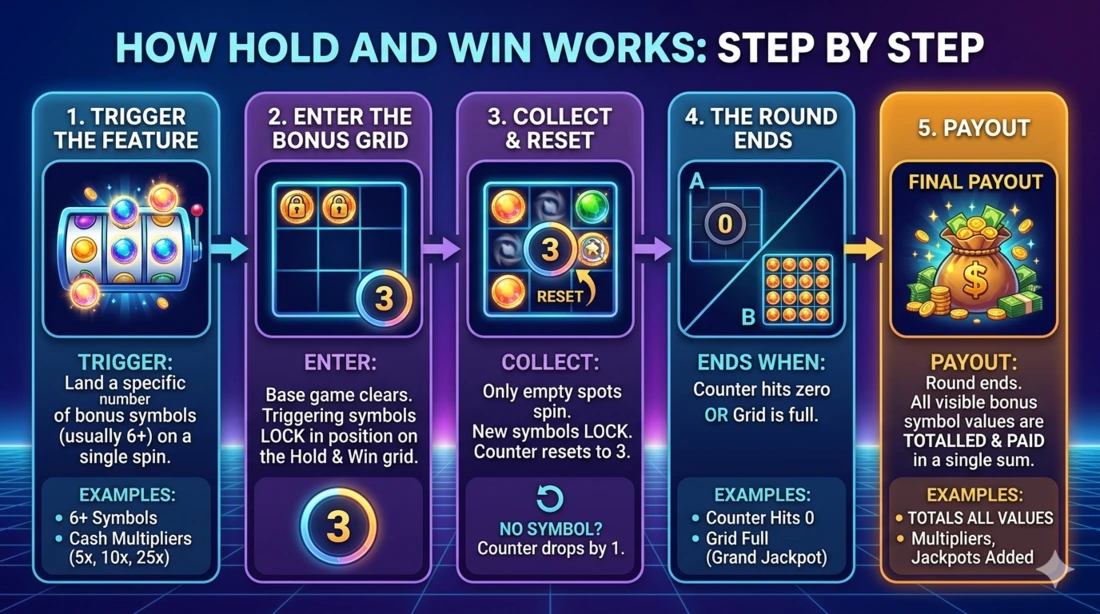
1. Trigger the feature in the base game
The feature activates when a specific number of bonus symbols land on the reels in a single spin. Most games require six or more, though some trigger with as few as three. These symbols are usually coins, orbs, or specially marked icons that carry a cash value (typically expressed as a multiplier of your bet — for example, 5x, 10x, or 25x).
2. Enter the Hold and Win bonus grid
When the trigger threshold is hit, the base game clears and the Hold and Win feature begins. The triggering symbols lock into their positions on the grid and remain there for the duration of the bonus. The counter resets to three respins.
3. Collect more symbols
During each respin, only the empty positions spin. Locked symbols stay exactly where they are. Every time a new bonus symbol lands on an empty position, it locks in place and the respin counter resets to three. If no new symbol lands, the counter drops by one.
4. The round ends
The bonus ends in one of two ways: either the respin counter reaches zero with empty positions still on the grid, or every position on the grid fills with symbols. A full grid typically awards the game's top jackpot on top of all the individual symbol values.
5. Payout
When the round ends, all visible bonus symbols have their values totalled and paid out in a single sum. Some games also layer in multipliers, collect symbols, or jackpot triggers on top of the base values.
The Respin Counter Explained
The respin counter is the engine that drives Hold and Win's tension. It almost always starts at three — a number low enough to feel precarious but high enough to feel survivable.
What makes the counter compelling is the reset mechanic. Every new symbol that lands brings you back to three. This means a round that looked finished — counter at one, no symbols for two spins — can be completely revived by a single lucky drop. The counter creates a rhythm of near-misses and reprieves that keeps the feature engaging regardless of whether the total payout ends up large or small.
Some games vary the starting number. A handful use five respins for harder-to-trigger versions of the feature. Others reset to two on certain symbol types. The principle is always the same: new symbols buy you more time, and time means more symbols.
Jackpot Tiers: Mini, Minor, Major, and Grand
Most Hold and Win slots layer a fixed jackpot structure on top of the base coin values. The typical format uses four tiers:
Mini — The smallest fixed prize, often in the range of 10x–25x your bet. Awarded for landing a specific jackpot symbol during the feature.
Minor — A mid-range prize, typically 50x–100x. Again triggered by a dedicated jackpot symbol landing during respins.
Major — A larger fixed prize, often 250x–500x, triggered by its own symbol.
Grand — The top prize, usually only awarded by filling the entire grid with bonus symbols. This is the "fill the board" jackpot — the biggest outcome in the feature and often worth 1,000x or more of the bet.
The key thing to understand about these jackpots is that they are fixed, not progressive (unless the game specifies otherwise). They do not grow over time. The Grand jackpot in a game paying 1,000x will always be 1,000x regardless of how long since the last player won it. This makes the Hold and Win format different from progressive jackpot slots, where the top prize accumulates from a percentage of every bet placed.
Some games — particularly those from 3 Oaks and Playson — combine fixed jackpot tiers with an expanded grid that unlocks during the feature, adding rows as more symbols land. In these versions, filling the expanded grid can be significantly harder, but the jackpot values scale accordingly.
Hold and Win vs Free Spins: What's the Difference?
This is the most common question about Hold and Win, and it's worth answering precisely because the two features feel completely different to play — even though both are bonus rounds triggered by base game symbols.
Free spins give you a set number of pre-paid spins on the full grid. The wins you collect during those spins work exactly like base game wins — symbol combinations, paylines or ways, multipliers applied to individual wins. The unpredictability is high: you might land ten dead spins followed by one enormous win, or collect consistent mid-range hits across all your spins.
Hold and Win is fundamentally different. Instead of standard reel outcomes, you're collecting locked symbols of known value. There are no paylines and no combinations in the traditional sense. The payout at the end is the sum of everything you managed to collect, plus any jackpot tiers triggered. The feature has a clear beginning and end — the respin counter ticking down gives you a defined arc — whereas free spins are more open-ended.
The psychological experience is also distinct. Free spins feel expansive and open. Hold and Win feels concentrated and pressurised — every spin matters, every new symbol is a direct addition to your running total, and the counter creates a tension structure that free spins don't have.
From a volatility perspective, both mechanics tend to produce infrequent but large bonus payouts relative to the base game. Hold and Win bonuses specifically tend to be more binary in their outcomes: either you collect a handful of symbols and exit with a modest win, or you hit a run of new symbols and find yourself well into four-figure multipliers chasing the Grand jackpot.
Variations of the Hold and Win Feature
Because the mechanic has been widely adopted for over a decade, providers have built significant variation on top of the core structure. Here are the most important variations to understand:
Multiplier symbols
Some games add symbols that multiply the values of other locked symbols. A 2x multiplier coin touching three standard coins doubles their individual values at payout. Games like Pragmatic Play's Wolf Gold and Playson's Royal Coins series use this to dramatically increase the ceiling of a given bonus round.
Collect symbols
A collect symbol gathers all current values on the grid into a single symbol at the collect position. In Dragon Pearls: Hold and Win by 3 Oaks, blue pearl symbols collect the values of every orange pearl on the board — instantly compressing scattered small wins into a single large one.
Expanding grid
Several 3 Oaks titles, including Aztec Fire: Hold and Win, use an expandable grid. The bonus starts on a standard 5×4 layout, but landing enough symbols unlocks additional rows — up to a 5×8 grid in some versions — increasing both the number of available positions and the jackpot values attached to filling them.
Reel Multiplier overlay
Rather than assigning values directly to coins, some games place multipliers above the grid columns and use Instant Win symbols to cash them out. Behind Bars: Masterplan (Bullshark Games) builds this into a full mechanic: Booster symbols stack and multiply the top-row values before any Instant Win symbol lands, creating a "build then cash" structure that produces dramatic single-symbol payouts rather than gradual accumulation.
Nested Hold and Win (game within a game)
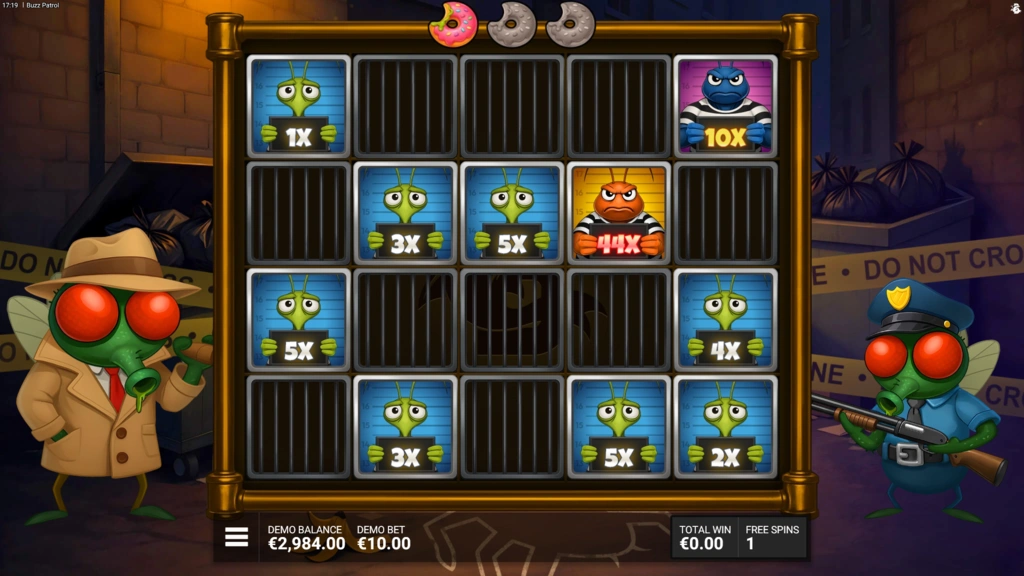
Buzz Patrol (Bullshark Games) introduces a Mini Game Symbol that, when it lands, spawns a miniature 3x3 Hold and Win grid inside the single cell where it appeared. That tiny grid runs its own respin loop independently, and the total it generates becomes a single Instant Win value on the main grid. It's a structural innovation — Hold and Win inside Hold and Win — though it sits on top of otherwise standard bonus mechanics.
Safety net respins
Behind Bars: Masterplan's Search Party mechanic — which randomly drops 2–4 Instant Win symbols and resets the counter if a respin produces nothing — represents a meaningful design evolution. It transforms the most frustrating moment in Hold and Win (watching the counter drain on dead respins) into a possible reprieve, and changes the psychological experience of a "near-miss" bonus entirely.
Hold and Win as one of two bonus modes
Tango of Chaos (Peter and Sons) treats Hold and Win as a secondary bonus alongside persistent-multiplier Free Spins, accessible via separate buy options. The coin-grid bonus in this game uses caged Row and Reel Multipliers that unlock as symbols accumulate — rather than fixed jackpot tiers — giving the fill-the-board goal a different mechanical payoff.
How Hold and Win Affects Volatility and RTP
Hold and Win slots sit predominantly in the medium-to-high volatility range. The base game is usually thin — low-paying symbol combinations, minimal feature frequency — because the mathematical model loads most of the return into the bonus. When the bonus hits, it is expected to pay significantly more than a typical free spins round of similar length. When it doesn't hit, sessions can feel very dry.
This means bankroll management matters more than usual with Hold and Win games. The feature might not trigger for 80–120 spins. When it does, the payout should reflect that wait — but "should" is doing work in that sentence. A run of small Hold and Win bonuses (three symbols trigger, respin counter reaches zero quickly) is entirely within normal variance, and a series of those will drain a bankroll faster than many players expect.
RTP in Hold and Win slots generally sits in the 95%–96.5% range, consistent with the wider slot market. One important nuance: several games offer a slightly elevated RTP when the bonus buy feature is used to access the Hold and Win round directly. This is because the bonus buy skips the lower-RTP base game entirely and accesses the higher-RTP bonus math model at a premium cost.
If you see two RTP figures listed for the same game — for example, 96.06% base and 96.58% feature buy — the higher figure applies to the purchased version. Neither figure guarantees your results in any individual session; both describe long-run theoretical returns across millions of simulated bonus rounds.
Hold and Win Slots Reviewed: What Good and Bad Look Like
The Hold and Win format has been implemented so many times by so many providers that quality varies enormously. Some studios genuinely innovate on the core mechanic; others wrap the same respin loop in new artwork and ship it. The games below — all reviewed by Chase the Scatter — illustrate both extremes, and several points in between.
Necromancer's Gate — Relax Gaming
RTP: 96.10% | Volatility: High (9/10) | Max Win: 25,000x | Our Score: 8.20/10
Read our full Necromancer's Gate review →
Relax Gaming doesn't use a straightforward coin grid — Mystery Skulls only reveal when a Ghoul Activator lands on reel 3, and each Ghoul multiplies all others before the skulls open. The Hold and Win round adds modifier symbols (Inferno Staff, Monocle of Doom, Soul Collector) that compound the values already on the board. The ceiling is determined by modifier combinations, not grid positions filled — a fundamentally different risk profile. The 25,000x max win and a 7x5 grid expansion during Chaos Spins make this the highest-upside implementation in our reviewed set. The Reel 3 dependency is its one genuine flaw: sitting with 16 locked skulls waiting for a Ghoul that doesn't come is genuinely brutal.
Behind Bars: Masterplan — Bullshark Games
RTP: 96.29% | Volatility: Medium | Max Win: 12,000x | Our Score: 7.45/10
Read our full Behind Bars: Masterplan review →
Six Reel Multipliers sit above the 6x5 grid, ranging 1x–100x. Instant Win symbols cash out their column's current multiplier — and Booster symbols let you stack those multipliers before any cash-out happens. The Search Party mechanic is the standout: if a respin produces nothing, the game can randomly drop 2–4 Instant Win symbols and reset the counter. It converts the most frustrating Hold and Win outcome — dead respins draining the counter — into a possible reprieve. The 12,000x max win on medium volatility is an outstanding risk-to-reward ratio for the format.
Tango of Chaos — Peter and Sons
RTP: 96.26% | Volatility: High | Max Win: 10,000x | Our Score: 7.30/10
Read our full Tango of Chaos review →
Hold and Win here is one of two bonus modes, not the whole game. The coin-grid Bonus Game uses caged Row and Reel Multipliers (up to 10x) that unlock as symbols accumulate — rather than fixed jackpot tiers — giving the fill-the-board goal a different payoff structure. Bonus buys are priced at 50x and 60x, well below the 100x–120x industry norm. That accessibility is a double-edged signal: a 50x buy price implies the average return will land in that range, so hitting the top end requires multiple runs.
Buzz Patrol — Bullshark Games
RTP: 96.31% | Volatility: Medium | Max Win: 10,000x | Our Score: 6.63/10
Read our full Buzz Patrol review →
The graphics are genuinely industry-leading — a macro-lens backyard aesthetic with expressive guard-fly characters that would top any best-visuals ranking for 2026. The mechanics underneath are standard. The one structural idea is the Mini Game Symbol: it spawns a miniature 3x3 Hold and Win grid inside the cell where it lands, and the total that grid produces becomes a single Instant Win on the main board. Creative, but it sits on top of an otherwise textbook respin loop. The 10,000x ceiling on medium volatility is the game's practical selling point — you get meaningful upside without extreme variance swings.
3 Cursed Chests: Hold & Win — Hacksaw Gaming
RTP: 96.31% | Volatility: Medium | Max Win: 2,500x | Our Score: 6.25/10
Read our full 3 Cursed Chests review →
Included here as a clear example of the ceiling problem. Hacksaw Gaming built their reputation on 15,000x–50,000x max win slots; this caps at 2,500x. The Hold and Win bonus (Cursed Coins, triggered by the Red Chest) is mechanically competent but entirely standard. The Ghostly Gallows super bonus — where every Pot symbol immediately activates its chest — is genuinely chaotic fun. But a 200x bonus buy against a 2,500x ceiling is a severe value mismatch, and the 47% hit frequency produces constant tiny wins that feel like bankroll drag rather than entertainment. The max win is simply too low for the tension this mechanic is supposed to generate.
Can You Buy the Hold and Win Feature?
Many Hold and Win slots include a bonus buy option that lets you pay a fixed premium — typically 50x–100x your base bet — to access the Hold and Win feature directly, bypassing the base game trigger.
For Hold and Win specifically, the bonus buy tends to be particularly attractive compared to free spins bonus buys. The reason is trigger frequency: because the feature requires a relatively large number of specific symbols to land simultaneously, organic triggers can be infrequent and unpredictable. The bonus buy removes that wait and accesses the feature's math model directly.
The trade-off is cost. A 100x bonus buy on a £1 bet costs £100 per feature entry. If your Hold and Win session produces three or four low-symbol bonuses in a row, the effective cost of accessing the feature's variance runs high very quickly. Bonus buys make the most sense as an occasional tool for players who want to experience the feature's upside without enduring extended dry spells in the base game — not as a regular playing strategy.
Note that bonus buys are restricted or banned in several regulated markets. UK players cannot access bonus buy features under UKGC rules.
The Bottom Line on Hold and Win
Hold and Win is one of the most durable mechanics in online slots because it solves a genuine design problem: how do you give players a bonus round that feels fair, readable, and exciting without requiring them to understand complex symbol combinations or reel engines? The answer — lock what you've earned, keep spinning for more, fill the board for the top prize — is immediately intuitive, and that simplicity is why it has outlasted dozens of formats that came and went around it.
The flip side of that durability is saturation. Because the mechanic is easy to implement and reliably popular, the market is flooded with titles that use the same mathematical blueprint with different artwork on top. When you're choosing a Hold and Win game, the questions worth asking are straightforward: What does this game do with the format beyond the basic coin loop? What's the max win relative to the bonus buy cost? And does the base game do anything interesting, or is it purely a waiting room?
The best Hold and Win slots — like Necromancer's Gate or Behind Bars: Masterplan — treat the respin mechanic as a foundation to build on, not the finished product. The weakest ones deliver exactly what you've already seen, wrapped in a new theme. Knowing the difference before you spin is what this guide is for.
Recommended Slots



Frequently Asked Questions
Everything you need to know about this guide
About the Author

Lead Developer & Slot Reviewer at Chase the Scatter
Lead Developer at Chase the Scatter, with 10+ years of personal gambling experience and a deep knowledge of slot mechanics, volatility, and bonus features. Karla brings a rare dual perspective to slot reviews — she builds the platform and has spent years as a high-stakes player across leading providers.