Wild Symbols in Slots Explained: Every Type of Wild & How They Work

CEO & Co-Founder
Quick Answer: What Are Wild Symbols in Slots?
Wild symbols in slots are special icons that substitute for other regular symbols to help complete winning combinations on the reels. They function like a joker in a deck of cards — filling the gap wherever a matching symbol is missing from a payline. Wilds are the most common special symbol in online slots and can appear in many forms, from basic substitutes to Expanding Wilds that fill entire reels and Multiplier Wilds that boost your payout by 2×, 3×, or more.
In most games, wild symbols cannot replace Scatter symbols or Bonus symbols. The paytable will always tell you exactly what the Wild can and cannot do.
Why Wild Symbols Matter for Every Slot Player
The wild symbol is the single most recognisable icon in the history of slot machines. Whether you are spinning a classic 3-reel fruit machine or navigating a modern 6-reel Megaways engine, the wild is the symbol every player wants to see land on the reels.
Its job sounds simple — substitute for other symbols to complete winning combinations — but in modern online slots, wild symbols have evolved far beyond basic substitution. Today's games feature expanding wilds that fill entire reels, sticky wilds that lock in place for multiple spins, and multiplier wilds that can turn a modest win into a massive payout.
This guide breaks down how wild symbols work in slots, covers every major wild type you will encounter, and shows you how to evaluate a game's wild mechanics before you play. By the end, you will understand why the wild symbol is the backbone of modern slot design — and how to use that knowledge to pick games that match your play style and bankroll.
How Do Wild Symbols Work in Slots?
A wild symbol works by stepping in for any regular symbol that is needed to complete a winning payline. If you land two matching symbols on adjacent reels and a wild appears on the next reel in the sequence, the wild counts as the missing third symbol, completing the combination and triggering a payout.
There are two fundamental rules that apply to wild symbols in almost every slot game:
Wilds cannot replace Scatters or Bonus symbols. These special icons operate on separate systems — Scatters trigger features regardless of position, while wilds work within the payline structure. The only notable exception is the "Book" mechanic (popularised by Book of Dead), where one symbol is designed to act as both the Wild and the Scatter simultaneously.
Wilds may or may not carry their own payout value. In many slots, a full payline of wild symbols is the highest-paying combination on the entire paytable. In other games, the wild exists purely as a substitute with no standalone value. Always check the paytable before you play — this detail directly affects the game's win distribution.
Where Do Wild Symbols Appear on the Reels?
Not every wild symbol can land on every reel. Game designers use reel restrictions as a key balancing tool to control how often wilds contribute to wins. Understanding these restrictions is essential for evaluating any slot before you play.
Wilds on all reels — the most generous configuration. The wild can land anywhere on the grid, maximising substitution opportunities. This is common in low-to-medium volatility games designed for longer, steadier sessions.
Wilds on middle reels only (reels 2, 3, and 4) — the most common restriction in 5-reel slots. By removing wilds from reels 1 and 5, the developer reduces the chance of full-line wild wins while still allowing the symbol to connect partial combinations from either direction.
Wilds restricted to bonus rounds — some high-volatility games lock wild symbols entirely behind the free spins feature. The base game contains no wilds at all. Once the bonus triggers, wilds flood the reels — often with enhanced properties like multipliers or sticky behaviour. This creates a stark contrast between a quiet base game and an explosive bonus round.
The paytable or game info screen will always specify which reels the wild appears on. Checking this takes five seconds and directly affects how the game will feel during your session.
Types of Wild Symbols in Slots: A Complete Breakdown
The basic wild symbol is just the starting point. Over the past decade, slot developers have engineered increasingly creative wild variants — each designed to add a specific layer of volatility, excitement, or win potential to the game. Below is every major type of wild symbol you will encounter in modern online slots.
What Is a Standard Wild?
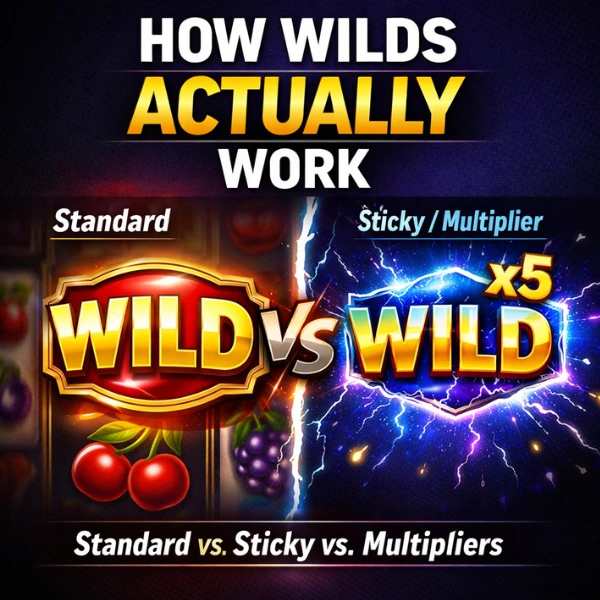
The standard wild occupies a single position on the reels and substitutes for all regular symbols. It carries no additional features — no multiplier, no expansion, no persistence. It simply fills a gap in a winning combination.
Standard wilds are found in virtually every slot on the market. When a game is described as having "wild symbols" without further specification, this is what it means. Simple, consistent, and effective.
What Are Expanding Wilds in Slots?
An expanding wild starts as a single symbol on the reels, then grows to cover the entire reel from top to bottom. On a standard 5×3 grid, an expanding wild on reel 3 fills all three positions on that reel, creating a full column of wilds. This dramatically increases win potential because the expanded wild participates in every active payline that crosses that reel.
Expanding wilds are the signature feature of NetEnt's Starburst — one of the most played slots in history. When an expanding wild lands on reels 2, 3, or 4, it fills the reel and triggers a re-spin with the expanded wild locked in place. Some games also feature horizontally expanding wilds that grow across a row rather than down a column, though this is less common.
What Are Sticky Wilds and How Do They Work?
A sticky wild locks into its position on the grid and remains there for a set number of subsequent spins — or for the entire duration of a bonus round. While a standard wild disappears after the spin resolves, a sticky wild persists, giving you multiple opportunities to form winning combinations around it.
Sticky wilds are most commonly found during free spins features. Each time a new wild lands in the bonus, it sticks to the grid alongside previously collected wilds. By the end of the round, the reels can be heavily populated with wild symbols, creating a snowball effect that drives the largest payouts.
Dead or Alive 2 by NetEnt is the definitive sticky wilds slot. In its High Noon Saloon free spins mode, every wild that lands is sticky for the remainder of the round. Fill all reels with sticky wilds and you hit the maximum win — a mechanic that has given this game a cult following among high-volatility players.
What Are Stacked Wilds?
Stacked wilds appear as a group of wild symbols stacked vertically on a single reel. Rather than occupying one position, you might see two, three, or a full reel of wilds land simultaneously. The difference between stacked wilds and expanding wilds is that stacked wilds arrive already occupying multiple positions — they do not animate or grow after landing.
When stacked wilds land across multiple reels on the same spin, the result is dramatic. Two fully stacked wild reels on a 5×3 grid can contribute to nearly every active payline simultaneously, producing large multi-line wins from a single spin.
What Are Walking Wilds (Shifting Wilds)?
A walking wild — also called a shifting wild — is a variant of the sticky wild that moves across the reels with each spin. Typically, the wild shifts one reel to the left after every spin, triggering a free re-spin each time it moves. The walking wild continues shifting and re-spinning until it exits the grid.
If a walking wild lands on reel 5 of a 5-reel slot, it triggers re-spins as it moves from reel 5 → 4 → 3 → 2 → 1 — giving you up to four additional spins from a single wild landing at no extra cost. When multiple walking wilds are active simultaneously, the re-spins continue until every wild has exited.
Jack and the Beanstalk by NetEnt is the classic walking wilds slot. The mechanic creates a satisfying rhythm: every wild that lands extends your session by several spins for free.
What Are Multiplier Wilds in Slots?
A multiplier wild does everything a standard wild does — substituting for other symbols — but it also carries a multiplier value applied to any win it helps create. If a 2× multiplier wild completes a payline that would normally pay 50 coins, the payout becomes 100 coins.
The mechanic becomes explosive when two or more multiplier wilds contribute to the same winning combination. In most games, the multiplier values are multiplied together rather than added. A 2× wild and a 3× wild on the same payline produces a 6× total multiplier — not 5×. This compounding effect is how the biggest wins in modern slots are generated.
Multiplier wilds are a staple of Hacksaw Gaming's design philosophy. Games like Wanted Dead or a Wild feature sticky multiplier wilds in the bonus round that persist and grow throughout the feature, creating the potential for enormous combined multipliers by the final spin.
How Do Random Wilds Work?
Random wilds are not produced by the reels themselves. Instead, the game engine randomly places one or more wild symbols onto the grid after the reels have stopped spinning. This can happen in the base game or during a bonus feature, depending on the game.
The visual effect is dramatic — you watch the reels stop, see no obvious win, and then a burst of wilds is injected onto the grid, transforming a losing spin into a winning one. Random wilds add genuine surprise to every spin and keep players engaged even when the reel result looks empty.
Thunderstruck II by Microgaming (now Games Global) uses random wilds in its Wildstorm feature, where up to five reels can be randomly turned fully wild on any base game spin.
What Are Colossal Wilds?
A colossal wild is an oversized wild symbol that occupies a block of positions on the grid rather than a single cell. The most common formats are 2×2 (four positions) and 3×3 (nine positions). Because of their size, colossal wilds span multiple reels and rows simultaneously, contributing to a large number of paylines at once.
Colossal wilds are relatively uncommon but highly impactful when they appear. They work best in games with larger grid formats (6×4 or bigger) where there is enough space for the oversized symbol to function without dominating the entire grid.
What Are Spreading Wilds (Infectious Wilds)?
Spreading wilds — sometimes called infectious wilds or raining wilds — convert adjacent symbols into additional wilds after landing. When a spreading wild hits the reels, it "infects" neighbouring positions, turning one or more surrounding symbols wild. If multiple spreading wilds land in close proximity, the chain reaction can ripple across the grid.
This mechanic is rarer than other wild types but creates some of the most visually exciting moments in modern slots. It is conceptually similar to random wilds, but spreading wilds are positionally driven — the spread originates from where the wild landed rather than being randomly distributed.
What Is a Nudge Wild?
A nudge wild activates when a wild symbol lands partially visible on the reels — for example, only one row of a stacked wild is showing at the edge of the visible area. The game then "nudges" the reel up or down by one position to bring the full wild symbol into view. This mechanic converts near-miss wild landings into actual wild contributions, which increases hit frequency and reduces the frustration of seeing a wild just barely miss the grid.
What Are Synced Wilds (Cloned Reels)?
Some games feature synchronised or cloned reels where two or more reels are guaranteed to display identical symbol layouts on a given spin. When a wild appears on one synced reel, it automatically appears in the same position on all linked reels — creating multiple wilds from a single landing event.
Twin Spin by NetEnt is the best-known synced wilds slot. On every spin, at least two adjacent reels are linked and display identical symbols, including wilds. Occasionally, three, four, or even all five reels sync together, producing enormous multi-line wins.
Wild Symbols vs. Scatter Symbols: What Is the Difference?
Wilds and Scatters are both classified as "special" symbols, but they serve fundamentally different functions in a slot game. Understanding the distinction is essential for reading paytables and knowing what to expect from each symbol.
Wild symbols are payline-dependent. They need to land in the correct position on an active payline to contribute to a winning combination. Their role is substitution — filling in for missing symbols.
Scatter symbols are position-independent. They pay out or trigger bonus features regardless of where they land on the grid. Their role is activation — unlocking free spins, bonus rounds, or instant payouts.
In most slots, wilds cannot substitute for scatters. Even if a wild lands next to two scatter symbols, it will not count as a third scatter to trigger the bonus. The two symbol types operate on entirely separate mechanics.
For a complete breakdown of scatter mechanics, see our Guide to Slot Scatters & Bonus Triggers. For information on pay-anywhere scatter mechanics specifically, see our Guide to Scatter Pays.
How Wild Symbols Affect Slot Volatility
The type, frequency, and placement of wild symbols in a game directly shape its volatility profile — and understanding this relationship helps you choose slots that match your bankroll and goals.
Frequent wilds in the base game = lower volatility. Games that scatter standard wilds generously across all reels during normal play tend to deliver steady, smaller wins. Your balance stays relatively stable, and sessions last longer. This is ideal for players with smaller bankrolls or those who prefer consistent action.
Powerful wilds locked behind the bonus = higher volatility. Games that restrict their best wild mechanics (sticky, multiplier, expanding) to the free spins feature create a stark contrast — quiet, low-hit base game followed by potentially explosive bonus rounds. This is the profile preferred by players hunting for maximum win potential who are comfortable with dry spells.
Wild symbols do not independently change a game's RTP. The Return to Player percentage is calculated across the entire math model. However, the way wilds distribute value — whether through many small wins or rare massive ones — is what defines how the game feels to play.
How to Evaluate a Slot's Wild Mechanics Before You Play
Before spinning any slot, open the paytable or game info screen and check these five things about the wild symbol:
1. Which reels can the wild land on? If wilds are restricted to middle reels only, base-game wild wins will be less frequent than in games where wilds appear on all reels.
2. Does the wild carry a multiplier? Multiplier wilds — especially those that compound when multiple wilds contribute to the same win — are the primary driver of big payouts in modern slots.
3. Is the wild available in the base game, the bonus, or both? Games that lock their best wild mechanics behind free spins will feel very different — longer dry spells, but more explosive bonus rounds.
4. Does the wild have its own payout value? If a full line of wilds is the highest-paying combination on the paytable, the wild is doing double duty — substituting and paying.
5. Can wilds interact with each other? Games where multiplier wilds compound (2× × 3× = 6×) have significantly higher theoretical max wins than games with flat multipliers or simple substitution wilds.
Recommended Slots


Frequently Asked Questions
Everything you need to know about this guide
About the Author
CEO & Co-Founder at Chase the Scatter
Former professional tennis player turned casino industry expert with over 10 years of experience in iGaming. Previously an operator at NOVOMATIC and Stanleybet Group, Borna now leads Chase the Scatter, delivering honest, data-driven slot reviews and expert gambling guides backed by real industry knowledge.