
Play Deck of Divinity Free DemoPlay Deck of Divinity Slot Demo for Free
Try the Deck of Divinity free demo below — no registration needed. With 20,000x max win potential and Very High volatility, it's worth a few free spins before deciding whether to play for real money.
Deck of Divinity
18+. Demo mode is for entertainment only.

Deck of Divinity
- RTP:96.22%
- Volatility:Very High
- Pay system:Scatter Pays
- Max Win:20000X
- Release:August 25, 2026
RTP
96.22%
Volatility
Very High
Max Win
20000x
Pay System
Scatter Pays
Release
August 25, 2026
 Free SpinsBonus Buy
Deck of Divinity Review (2026) – Print Studios | 20,000x, The Prize Chase & The Divine Deck Bonus

Reviewed on:
Updated:
TL;DR
The 30-second verdict
- 1The Divine Deck Bonus is one of the best "borrowed genre" mechanics in this catalogue — cards persist and upgrade instead of resetting
- 2A 5x4 Scatter Pays slot that turns full card-game collection into a working slot bonus, and pulls it off convincingly
- 3Nearly all the fun lives in Free Spins; the base game is thin, so the well-priced buy options matter more than usual

Stake
EXCLUSIVE 5% RAKEBACK VIA OUR LINK
Card Packs
A progress meter tracks every winning Symbol Card throughout the bonus, and reaching a new tier level opens a Card Pack — adding a batch of Prize Cards weighted toward that tier's value range directly into the deck, while also awarding extra Free Spins (Tier 5 packs add 12 cards and 5 spins; lower tiers scale down proportionally). This gives the bonus a genuine escalating structure: the deck itself gets richer as the round progresses, rather than staying static from start to finish.
Hidden Prize Cards
Before every spin, Hidden Prize Cards appear on 1 to 5 random grid positions. Once revealed, they transform into regular Prize Cards and become permanent additions to the deck going forward — meaning even a spin that doesn't win outright can still meaningfully strengthen your deck for the rest of the session.
Expert Insight: What makes this genuinely land, for someone who has never been a card game player in their free time specifically because of the learning curve, is how immediately legible every single piece of information is. You know exactly how many cards of which type sit in your deck at any moment. You can see which position on the grid hides a multiplier before it's revealed. You know precisely how far you are from the next retrigger tier. All the tactile, collection-based satisfaction of a real card game is here — and none of the "spend twenty minutes reading a rulebook" friction that usually comes with it.
Achievements and the Card Back Album
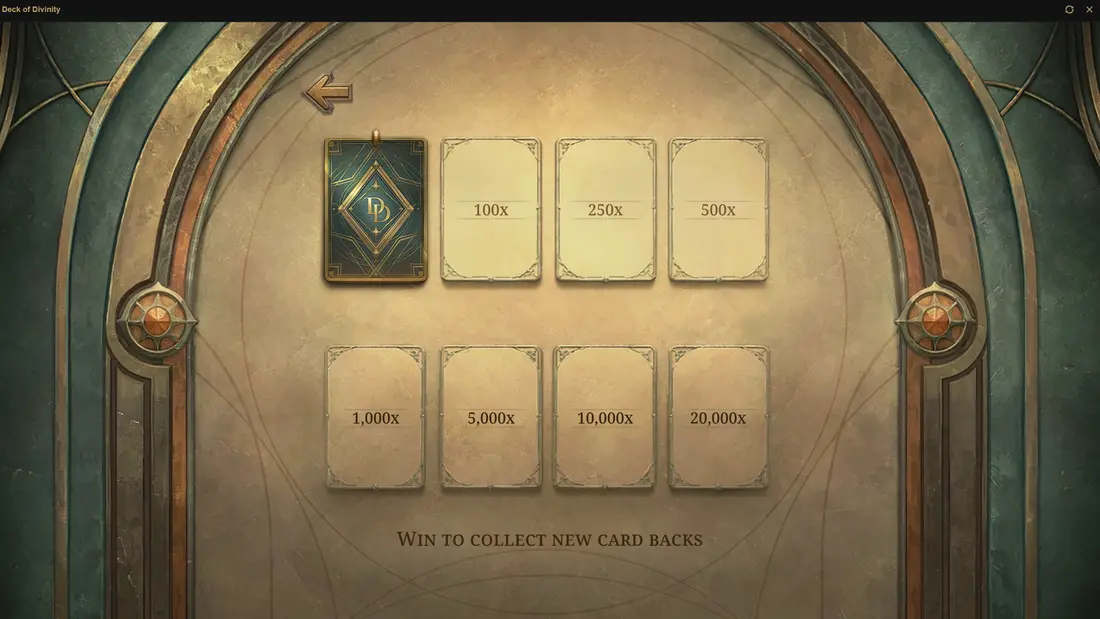
Triggering wins over certain thresholds unlocks Achievement awards — but rather than just a swap-in cosmetic menu, this functions like an album: unlocked card backs and deck components are displayed together as a visible collection, letting you see everything you've earned laid out at once, purely cosmetic with zero impact on the underlying mechanics or payout functionality. We've been critical of purely cosmetic collectible systems elsewhere in this catalogue, most notably in Money Plane's Golden Edition plane skins, which felt disconnected from anything the core mechanic was actually doing. Here, it's the opposite: a card game universe built around an actual collection album is exactly the kind of thing you'd expect from the genre it's drawing on — physical card games have always had binders and albums for exactly this purpose — so the cosmetic layer stays true to its own source material rather than feeling bolted on.
Potential & Entertainment: Nearly All the Weight Sits in the Bonus, and It Carries It
Potential Score: 8.00/10 | Entertainment Score: 9.10/10
Potential lands at a strong 8.00, driven by the genuinely large 20,000x ceiling, a competitive standard RTP, and a buy structure that covers both ends of the spectrum well — the excellent 208x ratio on the direct 96x Bonus Buy, plus the SuperSlider's continuous adjustability for players who want finer control over cost. The transparency of the 1 in 78,125,000 max win probability is a rare and welcome piece of honesty about just how far that ceiling actually sits.
Entertainment is the standout at 9.10 — and it's worth being direct about exactly why, and where the honest limitation sits. The main point of this entire game is localized in the Free Spins feature. The base game, while functional and reasonably active thanks to the 38.13% hit frequency, doesn't itself carry much entertainment weight on its own — it's a runway toward the Divine Deck Bonus rather than a destination in itself. That's precisely why having two well-designed purchase routes into the bonus matters so much: if the core appeal lives almost entirely inside the feature, a genuinely flexible SuperSlider alongside a genuinely well-priced direct buy means players of every risk appetite have an efficient way to get there. Once you're actually inside the Divine Deck Bonus, the deck-building, upgrading, and Card Pack escalation deliver on everything the base game promises and then some.
How Deck of Divinity Compares
Guitar Quest (Relax Gaming, 8.57/10) is the most directly relevant comparison, and not just because it shares the identical 9.50/10 Innovation score — both games follow the exact same successful formula of reaching outside the slot genre entirely to borrow something proven and translating it convincingly. Guitar Quest took Guitar Hero's fretboard-and-Collector-Bar tension; Deck of Divinity takes the collection-and-upgrade satisfaction of a physical card game. Both succeed for the same underlying reason: the borrowed mechanic isn't just reskinned, it's genuinely adapted to work as a slot feature while keeping the emotional core of its source material intact. Where Deck of Divinity pulls ahead is accessibility of design — Guitar Quest's Solo Mode requires you to be "in it" to fully register the tension, as that review itself admits, while Deck of Divinity's card-collection system is legible and satisfying from the very first spin without needing that same immersive threshold. The two land close overall (8.93 versus 8.57), with Deck of Divinity's stronger Graphics and Entertainment scores reflecting how completely its bonus delivers relative to Guitar Quest's more average 10,000x ceiling.
Sheeple (Shady Lady, 8.47/10) is the second comparison, and it's instructive specifically because Sheeple earns its own high Innovation score (9.40) through a completely different route — not by borrowing from outside the slot genre, but by combining two mechanics that already exist within it (symbol splitting and symbol merging) into a self-amplifying structure nobody had assembled quite that way before. Deck of Divinity's 9.50 edges past that by a narrow margin, reflecting how thoroughly its card-game translation reworks the collection-mechanic format specifically, rather than recombining existing slot components. Sheeple's own review flagged a missing persistent mechanic in its bonus — merge events that resolve dramatically but episodically rather than compounding — and Deck of Divinity's Divine Deck Bonus is the more structurally continuous of the two: cards genuinely persist, upgrade, and accumulate across the entire feature rather than resetting event to event. The 0.46-point gap (8.93 versus 8.47) reflects that structural continuity advantage directly, even though Sheeple's 20,000x ceiling matches Deck of Divinity's exactly.
Final Verdict: The Card Game That Finally Works for Non-Card-Game Players
Deck of Divinity succeeds at something genuinely difficult: taking the appeal of a physical card game — collecting, upgrading, chasing rarity — and translating it into a slot format that removes the exact friction that keeps people like us away from card games in the first place. The objective is instantly recognizable. The UI tells you everything at every moment. The theme is spot-on down to the visual execution being visible even in raw factsheet data. Two well-designed buy routes — the flexible SuperSlider and the well-priced 96x direct buy — matter enormously given how much of this game's actual entertainment value sits inside the Free Spins feature specifically.
It's not the first card-themed slot we've played. It's one of the best. If you've ever been repelled by the learning curve of an actual card game, this is the version built specifically to remove that barrier while keeping everything about the universe that made it appealing in the first place.
Deck of Divinity vs Guitar Quest vs Sheeple
Side-by-side comparison of key stats and features
Deck of Divinity

Guitar Quest
Relax Gaming
Deck of Divinity
Guitar Quest
Relax Gaming

Sheeple
Shady Lady
▲ indicates the better value in each category. For volatility, lower is considered better for most players. Scores are based on our independent testing and analysis.
Pros & Cons
Pros (5)
A genuinely successful translation of card-game collection mechanics.
An exceptionally legible UI at every moment.
Two well-designed, complementary buy routes.
A genuinely strong 20,000x ceiling with transparent max-win odds.
Card Packs give the bonus real escalating structure.
Cons (2)
The base game carries relatively little entertainment weight on its own.
High 9/10 volatility means real variance between sessions.
Frequently Asked Questions
Everything you need to know before you get started
About the Author

Lead Developer & Slot Reviewer at Chase the Scatter
Lead Developer at Chase the Scatter, with 10+ years of personal gambling experience and a deep knowledge of slot mechanics, volatility, and bonus features. Karla brings a rare dual perspective to slot reviews — she builds the platform and has spent years as a high-stakes player across leading providers.

Newest Slots from Print Studios
Explore more recently released slots.


Where to Play Deck of Divinity
Deck of Divinity is available at licensed online casinos offering Print Studios slots. It runs a 96.22% RTP with a 20,000x max win and very high volatility — making it one of the higher potential slots in its class. The Scatter Pays format is complemented by both a bonus buy and free spins features (bonus buy may be restricted in some regions).


There's almost a rule here, or at least one we keep noticing in our own reviewing: when a game reaches outside the iGaming and slot world to borrow something proven and executes it well, it really hits. Guitar Quest took Guitar Hero. Lucky Birds took Flappy Bird. Deck of Divinity by Print Studios takes the card game world, and does the same thing to it — it gives you the vibe of a collectible card game while flattening the exact learning curve that's always been the repellent for anyone who isn't already a card game player. This is a 5x4 Scatter Pays slot where 5 or more matching Symbol Cards anywhere on the board trigger cascading wins, and beneath those Symbol Cards sit stacked Prize Cards — 25 unique cards across five divine energies (Earth, Moon, Sun, Stars, Aether) and five tiers — that pay out their displayed value the moment they're uncovered. The Divine Deck Bonus builds an actual deck across the feature, with won Prize Cards upgrading before returning and Card Packs unlocking as you go. The max win is 20,000x, RTP tops out at 96.22%, hit frequency is 38.13%, and volatility runs 9/10. The objective here is instantly recognizable, the UI tells you everything you need to know at every moment, and this is one of the best executions of a card-game slot we've played — not because we're regular card game players, but specifically because we aren't, and this is the version of that universe that finally works for us.
Visuals & Theme: A Genuinely Spot-On Ethereal Card Aesthetic
Graphics Score: 9.10/10
The five divine energies — Earth, Moon, Sun, Stars, Aether — are rendered with real ethereal weight, and the whole cosmic-tablet, tarot-adjacent presentation lands exactly where it's aiming. This isn't just important for players who care deeply about art direction — the quality of the graphic execution is visible even in the raw game sheet data itself, which is a genuinely unusual thing to be able to say. The card designs carry real value hierarchy at a glance (a Tier 5 Aether card visually reads as more significant than a Tier 1 Earth card before you even check the number), and the layered stacking of Prize Cards beneath Symbol Cards gives the grid a tangible sense of depth. The 9.10/10 reflects a theme that's not just well-drawn but genuinely well-suited to communicating its own mechanics visually.
Technical Deep Dive: Strong Numbers, Two Genuinely Well-Designed Ways In
RTP: 96.22% (standard) / 96.17% (bonus) | 94.29% / 92.32% (UK) / 86.22% (German) | Volatility: 9/10 | Max Win: 20,000x | Hit Frequency: 38.13% | Bonus Frequency: 1 in 254 | Average Bonus Win: 93.55x | Max Win Probability: 1 in 78,125,000 | Grid: 5x4 | Bet Range: €0.10–€50
The standard 96.22% RTP clears the competitive threshold comfortably, and the 38.13% hit frequency at 9/10 volatility is a genuinely strong pace — nearly two in five spins connecting keeps the base game active even at this level of variance. The 20,000x ceiling is a solid, respectable number for 2026, and the documented 1 in 78,125,000 odds of hitting that full max win give a genuinely rare level of transparency about exactly how difficult that top end actually is.
SuperSlider™ and Direct Bonus Buy — Two Distinct Purchase Routes
Rather than offering only one fixed way to buy in, Deck of Divinity gives players two genuinely different options. The SuperSlider lets you drag a slider to adjust both cost and bonus trigger chance simultaneously, with the bonus chance scaling proportionally to whatever you're willing to pay — direct, continuous control over your own risk-reward trade-off rather than being locked into a small number of fixed price points. We can't recall seeing this specific implementation before, and it's a genuinely nice touch on its own.
Separately, there's also a straightforward direct Bonus Buy at 96x bet, guaranteeing entry into the Divine Deck Bonus outright. Running the ratio: 20,000x against a 96x cost gives an excellent 208x maximum return ratio — comfortably one of the stronger buy-to-ceiling ratios in this catalogue. Given how central the Free Spins feature is to this game's actual entertainment value (more on that below), having both a flexible, adjustable route and a simple, well-priced guaranteed entry sitting side by side is a genuinely strong combination — players who want fine-grained control over cost have the SuperSlider, and players who just want the surest, best-value path in have the direct buy.
Mechanics: A Card Game World, With the Learning Curve Actually Removed
Innovation Score: 9.50/10
The 9.50/10 is earned by doing something specific and difficult well: translating the appeal of a physical card game — collection, upgrade, hierarchy, the tactile satisfaction of revealing something valuable — into a format that doesn't require you to actually learn a card game to understand what's happening.
Cosmic Scatter Pays
Whenever 5 or more matching Symbol Cards land anywhere on the 5x4 board, a win triggers. Winning cards clear immediately, new ones fall into place, and the cascade continues. This is a clean, standard foundation — nothing revolutionary on its own, but it doesn't need to be, since the actual innovation lives in what's hiding underneath.
The Prize Chase
Twenty-five unique Prize Cards are divided across the five divine energies and five tiers, and every single one displays its value upfront — there's no hidden paytable consultation required to know what you're chasing. Prize Cards can stack up to three deep beneath a single Symbol Card, and once a Symbol Card clears, whatever Prize Card sits beneath it is immediately revealed and paid at its displayed value. Tier 5 cards reach genuinely significant numbers — 2,000x (Earth) up to a full 10,000x (Aether) — and because every card shows its worth openly, the entire chase is transparent in a way most collection mechanics in this genre aren't.
The Divine Deck Bonus — Build Your Deck
Landing 3 or more Bonus Cards triggers the Divine Deck Bonus, awarding up to 10 Free Spins (3 Bonus Cards = 8 spins, 4 or 5 = 10 spins, with 5 additionally guaranteeing a Hidden Prize Card on every single grid position every spin). Inside the bonus, Prize Cards genuinely persist as a deck: any Prize Card that gets won upgrades to the next tier before returning to the deck, meaning every reveal makes future reveals in that same session more valuable than the last. The current count of Prize Cards held at each tier is displayed directly next to the deck at all times — you always know exactly what you're working with.