
Duel.com Launches 100% RTP Rock Paper Scissors - Is This the Future of Online Casino Gaming?
Duel.com just launched a provably fair Rock Paper Scissors game with zero house edge and 100% RTP. Here's how it works and why it matters for online gambling.



A crypto casino just released a PvP game with zero house edge. Here's why that's a bigger deal than it sounds.
Online casinos have always had one thing in common: the house takes a cut. Whether it's a 1% edge on blackjack or a 5% rake on poker, the math has always been stacked against you. That's just how gambling works — or so we thought.
Duel.com, one of the most provocative names in crypto gambling right now, just launched a Rock Paper Scissors game with a 100% RTP and no house edge whatsoever. No rake. No commission. Just two players, one bet, and a winner takes all.
It sounds simple. But what Duel has pulled off here is genuinely significant for the industry — and if you look under the hood, the engineering behind it is elegant.
What Is Duel.com?
For those unfamiliar, Duel.com is a crypto casino launched in July 2025 by Ossi "Monarch" Ketola — the Finnish entrepreneur behind CSGOEmpire, one of the most recognised CS2 skin gambling platforms in the world. Built on a decade of experience in online gambling, Duel was designed from the ground up to fix what Ketola sees as the core problem with the industry: casinos quietly farming players through inflated house edges and opaque terms.
Duel's flagship promise is a 99.9% RTP on all in-house Originals, with an explicit long-term goal of reaching true 100% on select titles. The Rock Paper Scissors launch is the first major step toward that goal — and it's already live.
(Want the full breakdown of the platform? Read our Duel.com review for everything you need to know before you play.)
What Makes This Rock Paper Scissors Different?
On the surface, Rock Paper Scissors is about as simple as a game gets. But the version Duel has built is fundamentally different from anything else in the online casino space.
The key innovation: this is pure PvP. You're not playing against the house. You're playing against another real person. Duel simply provides the arena — the matching system, the cryptographic commitment scheme, and the payout infrastructure. They take nothing from the round itself.
That means the return-to-player is exactly 100%. Every dollar wagered goes back to a player. If you're not sure why that's extraordinary, our guide on what 100% RTP actually means explains the math behind it and why virtually no casino game in history has offered it at scale.
The closest comparison would be poker, where players compete against each other and the house takes a rake — but even there, the rake erodes your expected value over time. Duel's RPS takes nothing.
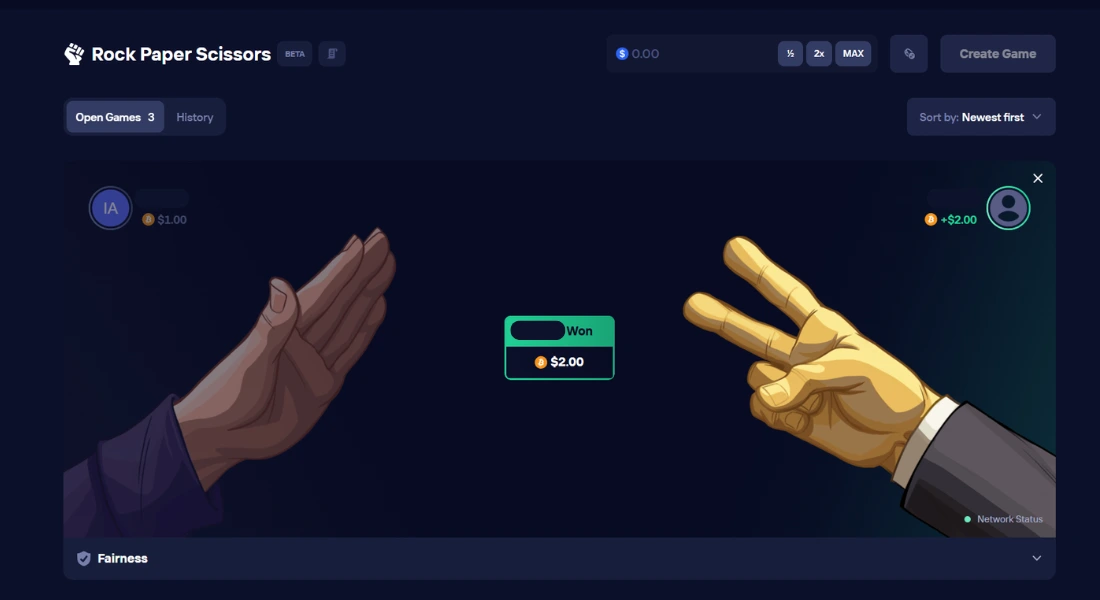
How to Play: Step by Step
The game is currently in beta , and the flow is clean and intuitive. Here's exactly how it works:
Step 1 — Browse or Create a Game When you land on the page, you'll see a live lobby of open games with player names, bet sizes, and accepted currencies displayed. You can join an existing game or hit "Create Game" to set your own terms — including bet size and which cryptocurrencies you're willing to accept from your opponent.
Step 2 — Join and Ready Up Click "Join" on any open game to enter as the second player. Once both players are in, you each hit Ready to begin the round. This triggers a 10-second countdown — you must make your pick within that window. If you close your tab or disconnect before the round ends, you may automatically forfeit. The clock is real.
Step 3 — Lock In Your Pick (Cryptographic Commitment) When you select Rock, Paper, or Scissors, your choice is immediately hashed using SHA256 combined with a client key — before your opponent can see it. This cryptographic commitment locks your pick in place. Neither player can see what the other chose, and neither can change their pick after the fact. More on exactly how this works below.
Step 4 — Reveal Once both players have committed, both picks are revealed simultaneously. The result is determined — scissors cuts paper, rock crushes scissors, paper covers rock. No ambiguity, no delay.
Step 5 — Payout The winner receives 2x their stake. If your opponent is playing in a different cryptocurrency than you, you'll receive your winnings in their currency — not your own. This is worth knowing before you play. You can pre-select which currencies you're willing to accept when creating a game.
Step 6 — Verify (Optional but Powerful) After the round, both players' client keys and picks are published. Anyone can recompute the hashes and confirm that neither player changed their selection mid-game. Complete transparency, no trust required.
The Cryptographic Commitment Scheme: How It Actually Works
This is the part that deserves a proper explanation, because it's genuinely clever and it's the entire reason this game is trustless.
The problem Duel had to solve is a classic one in computer science: how do two parties reveal information simultaneously without either side being able to cheat by going second? In a physical game of RPS, you solve this by throwing on a count of three. Online, with two players who may be thousands of miles apart, that's not possible without some form of cryptographic coordination.
Duel's solution is a commit-reveal scheme, which works like this:
Commit phase — When you lock in your pick, the client generates a random secret key and computes:
commitment = SHA256(pick + clientKey)That hash is submitted to the server and visible to both players. Your opponent can see you've committed — but the hash reveals nothing about whether you picked Rock, Paper, or Scissors.
Reveal phase — Once both players have submitted their commitments, each player reveals their original
pickandclientKey. The server (and anyone else) recomputes the hash and verifies it matches the commitment from step one.Verification — Because SHA256 is a one-way cryptographic hash function, it is computationally infeasible to find a
(pick, clientKey)pair that produces a given hash output after the fact. In plain English: you cannot reverse-engineer a cheating pick from a published commitment. If you committed to Scissors, you can't retroactively claim you picked Rock once you see your opponent chose Paper.
This is the same class of technique used in blockchain smart contract auctions, sealed-bid systems, and zero-knowledge proofs — applied here to a game of Rock Paper Scissors. The elegance is in the simplicity: no oracle, no trusted third party, no escrow contract required. The server facilitates the flow, but the math enforces the fairness.
Why PvP Changes the Economic Model
Beyond the cryptography, there's a business model insight here worth unpacking.
Traditional casino games are zero-sum against the house — you win, they lose; they win, you lose. The house edge is the mechanism that ensures they always win in aggregate. This model requires the operator to hold a float, manage risk, and price that risk into the edge.
PvP flips this entirely. Duel is functioning more like a protocol layer than a casino in the traditional sense — matching willing counterparties, enforcing the rules of the game, and processing payouts. Their revenue comes from the broader ecosystem (third-party slots, other Originals with thin edges, VIP structures) rather than from taxing this specific game.
This is structurally similar to how a DEX (decentralised exchange) earns fees on volume without taking directional risk on any individual trade. The comparison isn't accidental — this design thinking comes directly from the crypto-native world Duel.com was built in.
Our Take: Why This Matters
We'll be honest — when we first heard "crypto casino launches Rock Paper Scissors," our eyes glazed over. But after looking at how Duel has actually built this, we think it deserves serious attention.
What Duel is demonstrating is that a casino can compete on experience and infrastructure rather than edge. That's a meaningfully different business model, and it creates a product that is genuinely better for the player.
The immediate applications are obvious: low-stakes PvP wagering between friends is a natural use case, and users have already floated the idea of RPS tournaments. The format scales cleanly — best-of-three, winner-stays-on, bracket-style competitions. All of it becomes possible once you have infrastructure that handles commitment, revelation, and payout without a human referee.
More broadly, this is the kind of product that shifts what players expect from a casino. Once you've experienced a game with no house edge, the question you start asking everywhere else is: why is the edge this high?
That's a healthy question for the industry to be forced to answer.
Final Thoughts
Duel's Rock Paper Scissors is still in beta, the stakes are small, and the lobby is modest. But the concept is sound, the cryptography is well-implemented, and the implications reach far beyond one game.
We'll be watching closely to see whether the tournament format materialises, how the game scales with higher-stakes lobbies, and whether other operators feel pressure to respond with their own zero-edge PvP products.
For now, if you want to try it yourself, the game is live at Duel.com. And if you're weighing up whether Duel is the right platform for you, our full Duel.com review covers licensing, game selection, crypto support, and everything else you need to make an informed call.
The house edge has always been the one certainty in gambling. Duel just made it optional.